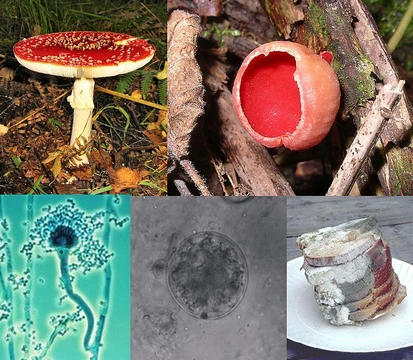
Frequently Asked Questions
The most-asked questions about fungi and fungus-like organisms.
What exactly are fungi?
Fungi are a distinct biological kingdom of eukaryotic organisms that absorb nutrients from their surroundings rather than photosynthesizing or ingesting food. They range from single-celled yeasts to the vast underground networks of mycelia that can span entire forest floors. Unlike plants, their cell walls are built from chitin rather than cellulose.
How do fungi differ from plants and animals?
Fungi sit in their own kingdom because they share traits with both sides but belong fully to neither. They grow by extending hyphae and absorbing dissolved nutrients externally, whereas animals digest internally and plants manufacture their own sugars through photosynthesis. Their chitin-based cell walls and heterotrophic metabolism set them apart from both groups.
What counts as a 'fungus-like organism'?
Fungus-like organisms are lineages that mimic fungal growth and ecology but evolved independently, including slime molds, water molds (oomycetes), and plant rusts. They were historically grouped with fungi before molecular phylogenetics revealed they belong to entirely different supergroups. In a fan encyclopedia they often get their own section because they look and behave like fungi without being true members of the kingdom.
What are the major phyla of true fungi?
The kingdom is divided into several phyla, the most familiar being Ascomycota (sac fungi), Basidiomycota (club fungi including most mushrooms), and Mucoromycota. Other notable groups include Chytridiomycota, which contains the pathogen behind the global amphibian decline, and Glomeromycota, which form symbiotic partnerships with plant roots.
What is mycology and who are some key figures in the field?
Mycology is the scientific study of fungi, encompassing their taxonomy, biochemistry, ecology, and applications. Pioneers like Christian Hendrik Persoon, who codified fungal nomenclature in the late 1700s, and modern researchers studying mycorrhizal networks and fungal genomics have shaped the discipline. The field bridges botany, microbiology, and ecology, which is why it attracts such a broad fan community.
What is the difference between a 'mushroom' and a 'fungus'?
A mushroom is simply the fleshy, above-ground fruiting body that many fungi produce for spore dispersal, while the fungus itself is the entire organism including the hidden mycelial network. Not all fungi make mushrooms—yeasts, molds, and truffles never produce the classic toadstool shape. Fans often use 'mushroom' colloquially to mean the whole organism, but technically it is just one reproductive structure.
What role do fungi play in ecosystems?
Fungi are primary decomposers, breaking down lignin and cellulose in dead wood and leaf litter and recycling nutrients back into the soil. They also form mycorrhizal partnerships with roughly 90 percent of land plants, trading minerals and water for plant-produced sugars. Without fungi, most terrestrial ecosystems would collapse because nutrient cycling would grind to a halt.
Are all mushrooms poisonous?
No—only a small fraction of the roughly 100,000 described mushroom species are toxic, and even fewer are lethal. Many species are prized edible delicacies, while others are used in medicine, such as the statin-producing Penicillium mold. The standard fan-encyclopedia advice is that no single field rule reliably separates safe from deadly species, so identification should always be confirmed by an expert.
What is a mycorrhizal network and why do fans call it the 'Wood Wide Web'?
A mycorrhizal network is a web of fungal hyphae linking the roots of multiple trees and plants, allowing the transfer of carbon, nitrogen, and chemical warning signals between them. The popular nickname 'Wood Wide Web' was popularized by forest ecologist Suzanne Simard and has become a fan-favorite shorthand for this underground communication system. Research is ongoing, and the extent to which trees actively 'talk' through these networks is still debated in the literature.
Where should a beginner start exploring fungi?
A good entry point is learning the five or six major phyla and recognizing a handful of iconic species—oyster mushrooms, chanterelles, death caps, and puffballs—before diving into spore-printing or microscopy. Local mycological societies and foraging walks offer hands-on identification practice, while open-access databases like Index Fungorum let you cross-reference every name you encounter. Starting with a single habitat, such as a decaying log or a grassland meadow, keeps the scope manageable and the discoveries exciting.