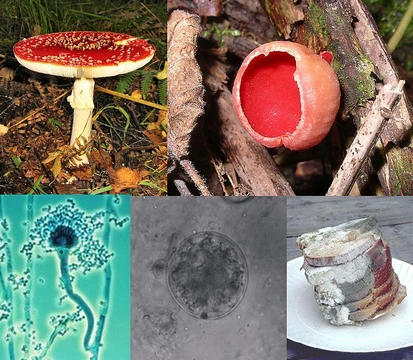
Evolution of fungi
Fungi diverged 1.5 billion years ago, colonized land, and survived mass extinctions.

Prof. Meike Piepenbring · CC BY-SA 3.0
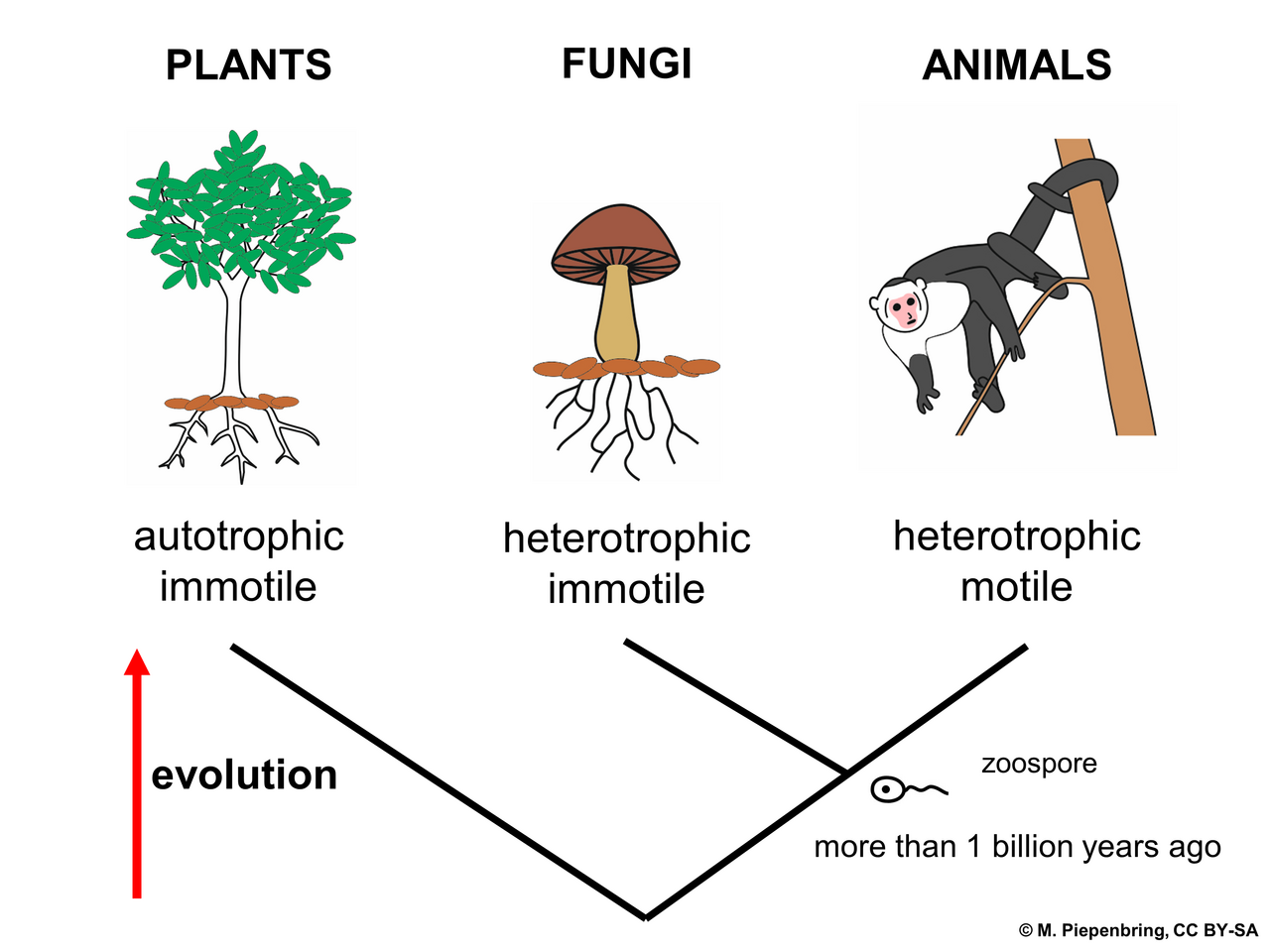
Fungi are a kingdom of eukaryotic organisms that diverged from other life around 1.5 billion years ago, according to DNA analysis. They likely originated in water and later colonized land, with their evolutionary history marked by key adaptations such as the loss of flagella and the development of diverse ecological strategies including parasitism, saprobism, and mutualism. The fungal fossil record is sparse due to their soft tissues and microscopic structures, but evidence suggests they may have been dominant life forms after major extinction events.
- origin
- ~1.5 billion years ago
- earliest_fossil_claim
- 2.4 billion years ago (Palaeoproterozoic Ongeluk Formation)
- terrestrial_colonization
- Possibly 635 million years ago (Ediacaran) or Cambrian (>500 Ma)
- uncontroversial_fossils
- Devonian (~400 Ma, Rhynie chert)
- divergence_from_animals
- Before first animal lineages (Ediacaran)
- key_adaptation
- Loss of flagellum early in evolution
Lore & Background
DNA analysis indicates that all fungi share a most recent common ancestor that lived at least 1.2 to 1.5 billion years ago, with glomaleans branching off before the dikaryan lineage, making them early-diverging fungi. The earliest fungi likely lived in water and possessed flagella. A 2.4-billion-year-old basalt from the Palaeoproterozoic Ongeluk Formation in South Africa contains filamentous fossils forming mycelium-like structures, which may push back fungal origins over a billion years earlier. The earliest terrestrial fungus-like fossils, from South China around 635 million years ago, are intriguing but their role in oxygenating the atmosphere remains speculative and is not supported by scientific consensus.
Reader's Guide
The evolution of fungi is significant because it reveals a kingdom that has persisted through major geological and biological transitions, from aquatic origins to terrestrial colonization, and through multiple mass extinctions. Fungi likely played a role in oxygenating Earth's atmosphere after the Cryogenian glaciations and were dominant life forms after the Permian-Triassic and Cretaceous-Tertiary extinctions. Their sparse fossil record, due to soft tissues and microscopic structures, makes each discovery—such as the 2.4-billion-year-old Ongeluk filaments or the 635-million-year-old South China fossils—critical for understanding early life. The divergence of fungi from animals before the Ediacaran underscores their deep evolutionary roots. Their legacy includes the development of mutualistic relationships like mycorrhiza and lichenization, which shaped terrestrial ecosystems. The lack of a mass extinction signal in fungal evolution at the K-T boundary, supported by molecular data, highlights their resilience.
Did You Know?
- Fungi diverged from other life around 1.5 billion years ago, with glomaleans branching off before the dikaryan lineage.
- A 2.4-billion-year-old basalt from the Ongeluk Formation contains filamentous fossils that may represent early fungi.
- The earliest terrestrial fungus-like fossils, from South China around 635 million years ago, are not confirmed to have helped oxygenate the atmosphere.
- After the Cretaceous-Tertiary extinction, a fungal bloom occurred, described as like 'a massive compost heap.'
Taxonomic Identity and the Hidden Census
Marine fungi defy a single taxonomic home; rather, they represent a collection of species united by their shared aquatic habitat. Roughly 2,149 species have been formally described, distributed across eleven phyla and 856 genera, yet this catalog captures only a sliver of reality. Estimates suggest fewer than one percent of all marine fungal species have been identified, a gap driven by the extreme difficulty of isolating fungal DNA from seawater and the impracticality of cultivating many of these organisms in the lab. Researchers therefore rely on rDNA analysis of material recovered from seawater samples to probe species that can never be grown in culture. A landmark 2011 phylogenetic study, built on small subunit ribosomal DNA sequences, revealed thirty-six previously unknown marine lineages, the majority belonging to chytrids, alongside filamentous and multicellular forms. The most commonly encountered species turned out to be ascomycetous and basidiomycetous yeasts. The group splits into two broad categories: obligate marine fungi, which reproduce exclusively in seawater, and facultative marine fungi, which normally inhabit terrestrial or freshwater settings but can still grow and sporulate in the marine realm.
Ecological Versatility Across Marine Niches
From the sunlit surface to sediments buried kilometers below, marine fungi have colonized virtually every aquatic niche explored. They thrive in mangrove swamps, estuaries with low salinity, coastal waters, and the open deep sea, attaching themselves to sponges, corals, mangroves, seagrasses, and algae. Their ecological functions span saprobic decomposition, parasitism of animals and algae, and symbiotic partnerships with other marine organisms. Some terrestrial-origin species burrow into sand grains, living within the tiny pores, while others reside inside stony corals and may turn pathogenic when the host is stressed by warming waters. Fungi are hypothesized to influence phytoplankton population cycles and the biological carbon pump, and they actively participate in the chemistry of marine sediments. Water temperature, salinity, current movement, substrate availability, propagule presence, interspecific competition, pollution, and dissolved oxygen all shape whether a fungal community establishes itself in a given location. Despite this remarkable versatility, marine fungi contribute only about five percent of total ocean biomass, a modest share that belies their outsized role in biogeochemical cycling.
The Persistent Knowledge Gap
A persistent and frustrating gap in marine biology surrounds fungal diversity. Although the ocean holds roughly ninety-nine percent of the biosphere's volume and microbial life drives its biogeochemical cycles, pelagic fungal biomass remains the most uncertain estimate among all oceanic organism groups, with values spanning more than two orders of magnitude. As of 2025, only a handful of studies have attempted to quantify pelagic fungal biomass, and each is confined to distinct coastal areas, leaving the vast open ocean essentially uncharacterized. The methods used across these studies differ, each carrying its own limitations that prevent robust comparison. Only about sixty-four of the roughly 2,149 described marine fungal species have been fully genetically sequenced, and many species are known solely from spores. The difficulty of targeting fungal DNA in seawater and the impracticality of growing marine fungal cultures in the laboratory compound the problem. Researchers have proposed that large-scale sampling across biogeographical provinces in the open ocean is essential to produce a precise, direct estimate of fungal biomass and to close the enormous gap between what exists and what we know.
Biochemical Promise and Symbiotic Networks
Beyond their ecological importance, marine fungi have attracted attention for their biochemical arsenal. The secondary metabolites they produce carry high potential for biotechnological, medical, and industrial applications, making them a promising frontier for drug discovery and industrial enzyme production. Their interactions with other marine life are equally significant: fungi have been identified as commensals and pathogens of corals, sponges, and other marine animals, as well as partners in symbiotic relationships with algae and plants. The 2016 definition proposed by Ka-Lai and colleagues broadened the scope of what qualifies as a marine fungus to include organisms that form symbiotic relationships with other marine organisms, adapt and evolve at the genetic level in marine environments, or are metabolically active in those settings. This wider framing acknowledges that fungi are not merely passive decomposers but active participants in marine food webs, shaping macroorganism communities as parasites and mutualists. Yet for a group that may number in the thousands of undescribed species, the full breadth of their biochemical and ecological contributions remains largely untapped.
Gallery
Frequently Asked Questions
Who is Evolution of fungi?
Evolution of fungi refers to the deep eukaryotic lineage that split from other branches of life roughly 1.5 billion years ago, as indicated by DNA analyses. The group most likely began in aquatic habitats before eventually making the leap to terrestrial environments. It is one of the oldest major lineages in the entire tree of life.
What are Evolution of fungi's powers or role?
The signature adaptation that set this lineage apart was the early loss of the flagellum, steering fungi away from the animal and plant paths. Over hundreds of millions of years they built a versatile ecological toolkit spanning parasitism, saprobism, and mutualism. That range of strategies is essentially their 'power set,' letting them exploit nearly every niche on the planet.
How does Evolution of fungi's story end?
There is no true finale; instead, fungi repeatedly rebounded after mass-extinction events and may have become dominant organisms in their wake. Because their soft, microscopic bodies rarely fossilize, the record is patchy and the narrative is still being revised. As of now the story is ongoing, with new lineages still diversifying.
Why is Evolution of fungi important?
Fungi were among the first eukaryotes to establish themselves on land, possibly by the Ediacaran or Cambrian, and their mutualistic alliances with early plants helped make complex terrestrial ecosystems viable. Their ongoing role in nutrient cycling and symbiosis means the history of life on land would be unrecognizable without them. They are a keystone thread running through the entire story of terrestrial biology.
When did Evolution of fungi first appear?
Molecular-clock estimates place the fungal split around 1.5 billion years ago, although a contested claim in the Palaeoproterozoic Ongeluk Formation pushes the date back to roughly 2.4 billion years. The first widely accepted fossils, such as those preserved in the Rhynie chert, date to the Devonian at about 400 million years ago. So the exact 'origin episode' remains an active debate among researchers.
More in Fungi And Fungus-Like Organisms 1-24
Spotted an error? Know more?
This is a living reference — every entry is fact-audited, and reader corrections feed straight into our audit queue. Suggest an edit · See this site's audit record