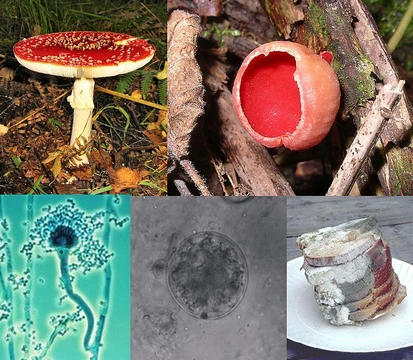
Fungi imperfecti
Fungi known only by their asexual and vegetative phases.

Fungi imperfecti, also called Deuteromycota, Deuteromycetes, or imperfect fungi, are fungi that do not fit into standard taxonomic classifications based on biological species concepts or morphological characteristics of sexual structures because their sexual form of reproduction has never been observed. They are known as imperfect fungi because only their asexual and vegetative phases are known, producing spores asexually through sporogenesis. About 25,000 species have been classified in this division, many of which are anamorphs of Basidiomycota or Ascomycota.
- field
- Mycology
- known_for
- Fungi lacking observed sexual reproduction; classified only by asexual forms
- species_count
- ~25,000
- alternative_names
- Deuteromycota, Deuteromycetes, anamorphic fungi, mitosporic fungi
- status
- No longer formally accepted as a taxon
Lore & Background
The fungi imperfecti were historically grouped together because they could not be placed into the established taxonomic systems that rely on sexual reproductive structures. Mycologists used a dual system of nomenclature, permitted by Article 59 of the International Code of Botanical Nomenclature, where asexually reproducing fungi were given form taxon names. For example, Aspergillus niger had no known sexual cycle and was considered a form taxon, while Aspergillus nidulans was later found to be the anamorph of Emericella nidulans, and under the old system the teleomorph name took priority. This dual system was abolished in the 2011 update of the Code, and since 2013 a single name is chosen for each species—the earliest legitimate name, which is not necessarily the anamorph.
Reader's Guide
The concept of Fungi imperfecti is significant because it represents a historical classification for fungi that could not be assigned to other groups due to the absence of observed sexual reproduction. Although the taxon Deuteromycota is no longer formally accepted, many of its members have yet to find a place in modern fungal classification, as most fungi are classified based on sexual fruiting bodies and spores. Molecular systematics, using DNA sequence comparisons, has allowed many asexually reproducing fungi to be placed in the tree of life, but sufficient biological materials from pure cultures are needed, and for many species their exact relationships remain undetermined. The group includes industrially important fungi such as those producing penicillin, the immunosuppressant ciclosporin, and those used in cheese production (e.g., Penicillium roqueforti and Penicillium camemberti), as well as pathogens like Magnaporthe oryzae. The ongoing debate in the mycological community about classifying and naming asexually reproducing fungi underscores the legacy of this artificial grouping.
Did You Know?
- Fungi imperfecti are called imperfect because only their asexual and vegetative phases are known.
- The dual nomenclature system for fungi was abolished in the 2011 update of the International Code of Botanical Nomenclature.
- Many fungi imperfecti have simply never been observed reproducing sexually; the absence of observed sex is not usually due to identified mutations or epigenetic changes.
- Some fungi imperfecti exhibit a 'parasexual cycle' that allows recombination without sex.
Frequently Asked Questions
What are Fungi imperfecti?
Fungi imperfecti, also called Deuteromycota or Deuteromycetes, are fungi whose sexual reproductive stage has never been directly observed. They are identified and sorted into groups solely through their asexual and vegetative growth phases, making them a catch-all category for species that don't fit neatly into other fungal divisions.
Why are they called 'imperfect' fungi?
The nickname 'imperfect' comes from the fact that only the asexual and vegetative phases of these organisms are known to science. Because no sexual structures have ever been documented, they lack the full reproductive life cycle that defines most other fungal groups.
How many species belong to Fungi imperfecti?
Roughly 25,000 species have been placed in this group over the years. Many of those turn out to be anamorphs—meaning their asexual forms—of species that actually belong to Basidiomycota or Ascomycota once a sexual stage is eventually discovered.
Is Fungi imperfecti still an officially recognized taxon?
No, Deuteromycota is no longer formally accepted as a valid taxonomic division in modern mycology. It persists as a handy working label for fungi whose sexual cycles remain unknown, but it functions more as a placeholder than a true biological classification.
How do Fungi imperfecti reproduce?
These fungi produce spores exclusively through asexual sporogenesis, since no sexual reproductive phase has ever been observed in them. Their vegetative and asexual stages are the only parts of the life cycle that mycologists can actually study and describe.
More in Fungi And Fungus-Like Organisms 1-24
Spotted an error? Know more?
This is a living reference — every entry is fact-audited, and reader corrections feed straight into our audit queue. Suggest an edit · See this site's audit record