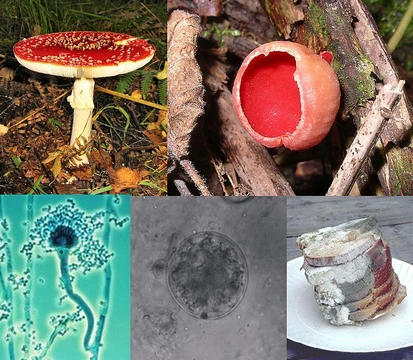
Fungus
Eukaryotic organisms including yeasts, molds, and mushrooms.

Fungi are a group of eukaryotic organisms that includes yeasts, molds, and mushrooms, classified in the biological kingdom Fungi. They are distinct from plants, bacteria, and some protists due to having chitin in their cell walls and being heterotrophs that absorb dissolved organic molecules, typically by secreting digestive enzymes. Fungi are the principal decomposers in ecological systems, playing essential roles in nutrient cycling and exchange, and over 90% of plants depend on mycorrhizal symbiosis with fungi. They have been used as food, in fermentation, for antibiotic production, and as biological pesticides, but also cause crop diseases, food spoilage, and human pathogens.
- field
- Mycology
- known_for
- Principal decomposers in ecosystems; source of antibiotics, food, and fermentation; cause of plant and human diseases
- number_of_estimated_species
- 2.2 million to 3.8 million
- number_of_described_species
- about 148,000
- number_of_species_pathogenic_to_plants
- over 8,000
- number_of_species_pathogenic_to_humans
- at least 300
Lore & Background
Fungi have long been used as a direct source of human food, in the form of mushrooms and truffles; as a leavening agent for bread; and in the fermentation of various food products, such as wine, beer, and soy sauce. Since the 1940s, fungi have been used for the production of antibiotics, and more recently, various enzymes produced by fungi are used industrially and in detergents. Fungi are also used as biological pesticides to control weeds, plant diseases, and insect pests. Many species produce bioactive compounds called mycotoxins, such as alkaloids and polyketides, that are toxic to animals, including humans. The fruiting structures of a few species contain psychotropic compounds and are consumed recreationally or in traditional spiritual ceremonies.
Reader's Guide
Fungi are fundamental to life on Earth as the principal decomposers, breaking down organic matter and cycling nutrients. Their symbiotic relationships with over 90% of plants enhance photosynthesis and help mitigate climate change by increasing carbon uptake. Historically classified as plants, fungi are now recognized as a separate kingdom more closely related to animals. Their economic and medical importance is vast: they provide food, leaven bread, ferment beverages, and produce antibiotics. However, they also cause significant crop losses, food spoilage, and human diseases. The true biodiversity of fungi is largely unknown, with an estimated 2.2 to 3.8 million species, of which only about 148,000 have been described. Advances in molecular genetics have reshaped fungal taxonomy, which now divides the kingdom into one subkingdom, seven phyla, and ten subphyla. Fungi are threatened by fungicides, pesticides, pollution, deforestation, and more.
Did You Know?
- Fungi are the only organisms that combine chitin and glucan in their cell walls.
- Over 90% of plants depend on mycorrhizal symbiosis with fungi.
- The word 'fungus' is derived from the Latin fungus 'mushroom', which in turn comes from the Greek sphongos 'sponge'.
- Only about 148,000 of an estimated 2.2 to 3.8 million fungal species have been described.
More in Fungi And Fungus-Like Organisms 1-24
Spotted an error? Know more?
This is a living reference — every entry is fact-audited, and reader corrections feed straight into our audit queue. Suggest an edit · See this site's audit record