Mold
Molds are diverse fungi that spoil food but also yield medicines and fermented foods.

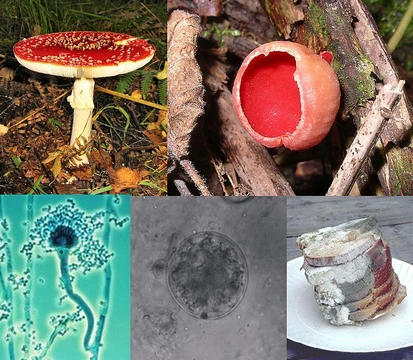
Molds are a large and taxonomically diverse group of fungal species that form visible, fuzzy colonies on organic matter. They are microbes that do not belong to a single taxonomic group but are found in the divisions Zygomycota and Ascomycota. Molds cause biodegradation of natural materials, leading to food spoilage and property damage, yet they also play essential roles in biotechnology and food science, producing pigments, foods, beverages, antibiotics, pharmaceuticals, and enzymes.
- field
- Mycology, Microbiology
- known_for
- Production of antibiotics (e.g., penicillin), food fermentation (e.g., soy sauce, cheese, tempeh), and biodegradation of organic matter
- common_genera
- Alternaria, Aspergillus, Cladosporium, Fusarium, Mucor, Penicillium, Rhizopus, Stachybotrys, Trichoderma
Lore & Background
Molds reproduce by producing large numbers of small spores, which may be asexual or sexual. Many spores are hydrophobic and adapted for wind dispersal, while others have slimy sheaths for water dispersal. Spores can survive extremes of temperature and pressure. A mold colony consists of an interconnected network of hyphae called a mycelium, with growth occurring at hyphal tips. Molds require moisture for growth; some are xerophilic and can grow in dry, salty, or sugary environments with water activity below 0.85.
Reader's Guide
Molds are significant because they are both destructive and beneficial. They cause food spoilage and damage to buildings, but they are also crucial in the production of many foods and medicines. The discovery of penicillin from a Penicillium mold revolutionized medicine. Molds are used to ferment soy sauce, sake, cheese, tempeh, and other products. They also produce enzymes, pigments, and mycotoxins. Their ability to decompose organic matter recycles nutrients in ecosystems. Molds can cause disease in humans through allergic reactions, pathogenic growth, or mycotoxin exposure. Understanding mold biology is essential for food preservation, industrial fermentation, and medical treatment.
Did You Know?
- The dusty, colored appearance of molds is due to spores containing fungal secondary metabolites.
- Molds can be found in the divisions Zygomycota and Ascomycota; many were formerly classified as Deuteromycota.
- Some molds produce hydrophobic spores that can remain airborne for long periods and are resistant to ultraviolet radiation.
- Xerophilic molds can grow in environments with water activity less than 0.85, such as salty or sugary foods.
More in Fungi And Fungus-Like Organisms 1-24
Spotted an error? Know more?
This is a living reference — every entry is fact-audited, and reader corrections feed straight into our audit queue. Suggest an edit · See this site's audit record